
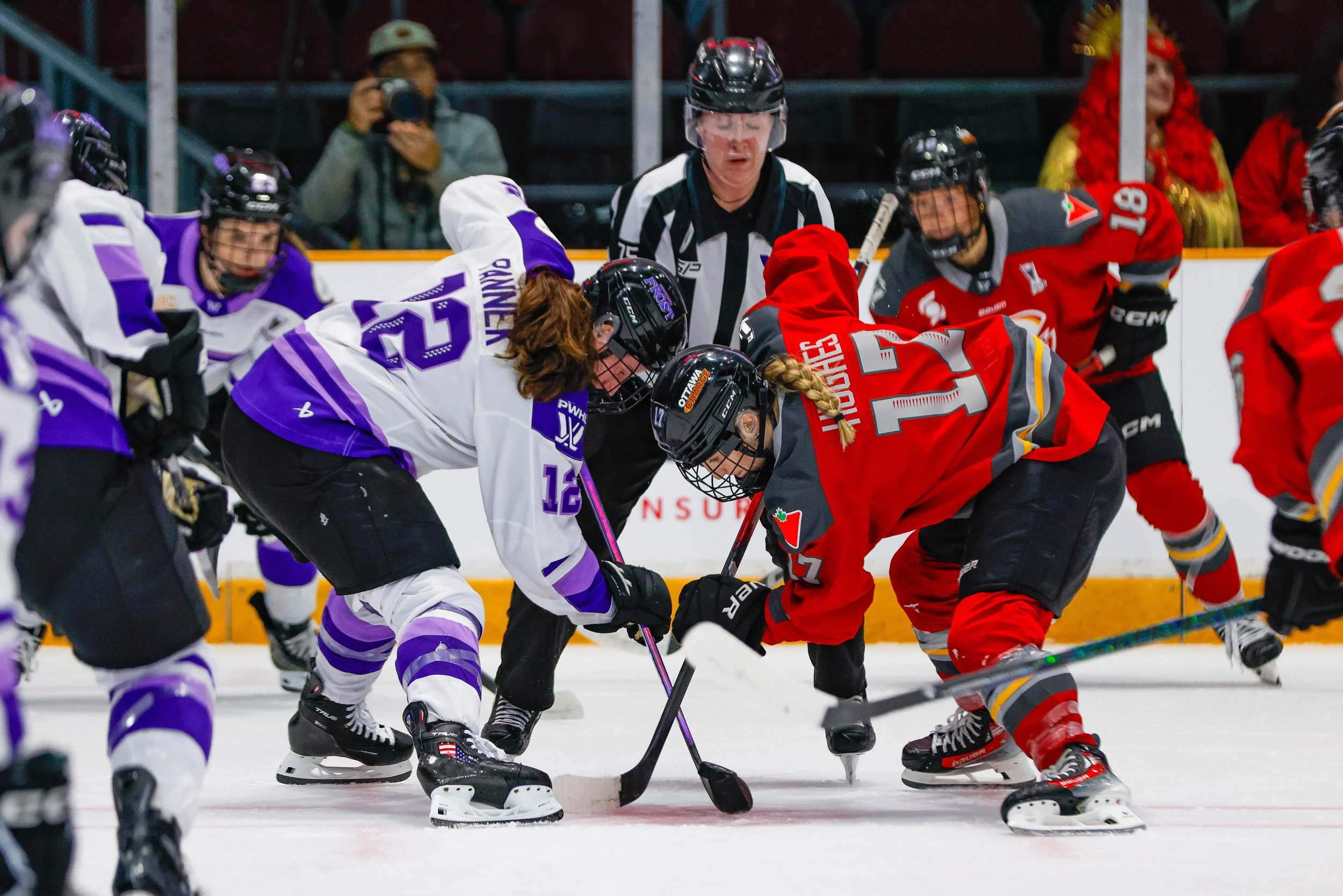
5 Storylines That Will Define The PWHL This Season
November 20, 2025
By Jolene Latimer
EDMONTON, AB — Ten months ago, the PWHL was staging showcase games in Seattle and Vancouver, two cities still waiting for official franchises, logos, or rosters. Today, both of those markets have transformed into fully built expansion teams with star players, sold-out merch, and some of the highest season ticket holder sales in the league. That dramatic shift is a window into the scale and speed of change happening across the PWHL as it enters its third season.
League executives Amy Scheer and Jayna Hefford used their season-preview press conference to underline the same idea in different ways: this is a league in rapid motion. And with a looming Olympic year that will put PWHL stars in front of a global audience before dropping them right back into the heart of the season, the future of women’s hockey has never held more promise.
“It’s hard to believe we’re entering season three,” Hefford said early in the call. “This offseason has been…as busy as any other has been to date for us.”
From expansion momentum to U.S. broadcast uncertainty to a possible relocation battle in Ottawa, here are the five biggest storylines that will shape the PWHL this season.
1. Can anyone build chemistry fast enough? With nearly every roster retooled, competitive balance is on the line
The question isn’t just how Seattle and Vancouver will fare in their debut seasons – it’s whether any roster in the PWHL will look or feel settled by opening night. Player movement was a dominant theme of the offseason, and even the established teams will start the season with new combinations, lineups and chemistry needs.
Hefford acknowledged the churn directly: “There certainly was some player movement and some significant player movement from teams,” she said. But she emphasized that the league tried to protect enough of each club’s identity to avoid a full reset: “It was important for us that teams could keep a core group, so obviously they could protect three players…and retain four of their top six.”
Still, the league’s foundational goal – competitive balance – will be tested immediately.
“When the puck drops on Friday, all eight teams are competing for the Walter Cup,” Hefford said. “There’s no expansion team that is going to take two or three years to build to be competitive. We wanted them all to be competitive on day one.”
The real question becomes: will fans stay engaged as their teams settle into entirely new identities? Season-ticket numbers suggest yes – at least for now – but how these women gel will be one of the defining week-to-week narratives of the early season.
2. The Olympic halo: Will Milano Cortina give the PWHL its biggest visibility surge yet?
Every four years, women’s hockey becomes one of the marquee sports at the Winter Games. This year, for the first time, fans who fall in love with players in February will be able to immediately follow them in a professional league in March.
“The Olympics is…the biggest sporting event in the world,” Hefford said. “It certainly is an opportunity for us, for our players to have more visibility…for some great storytelling, which we know is critical to the growth of their brands and the brand of the league.”
It’s also the first time the league can redirect viewers seamlessly: “This will also be the first time that people watching women’s hockey at the Olympics can figure out where to follow these players when the Olympics ends,” Hefford added.
On the business side, Scheer noted that the Olympics can create a measurable rising tide.
“There’s always a wonderful tailwind that you get to ride for a bit,” she said, referencing the post-Olympic bumps seen in the NWSL and WNBA.
The league is planning around that momentum.
“We’ve got a lot of plans…before, during and after the Olympics,” Scheer said. “We are taking the Olympics very seriously as something that could most certainly help elevate our business.”
3. The expansion horizon: Where does the PWHL grow next – and how many new teams are coming?
The league didn’t hide it: further expansion isn’t just coming – it’s imminent.
Scheer confirmed the evaluation process is already underway.
“We will be talking with interested markets and going through the evaluation process,” she said. “When we feel the time is right and we’ve got the right partners, we’ll announce where we’re expanding.”
When pressed on whether it would be two or four teams, Scheer simply said: “It’s fluid. You know, we like to keep you thinking.”
Seattle and Vancouver give the league two strong proof points. Scheer called them “two of our strongest markets” and noted that Vancouver ranks No. 1 in the league in season tickets, with Seattle at No. 3. Both cities also lead the league in opening-night attendance due to venue capacity.
Their off-ice numbers make a compelling argument for continued West Coast presence – but Quebec City, which Scheer called “magical” last season, remains a quiet contender, even if she refused to confirm it. The league uses its Takeover Tour – returning for another season – to test new markets, so expect attendance to offer clues on what cities they might expand to next.
For a league looking to build a truly continental footprint, this expansion cycle will determine strategic direction for the next decade.
4. The arena pressure cooker: Ottawa’s future puts every market under the microscope
Ottawa became the most urgent subplot of the press conference. Scheer didn’t mince words: “We will not go backwards. We will not play in a 5,500-seat building.”
She added: “These women have worked too hard to get to the point today where a 5,500-seat building is well below what we average in Ottawa.”
The league says every option is on the table – including relocation.
“We certainly don’t want to leave Ottawa,” Scheer said. “We chose Ottawa for a reason, and the fans have been wonderfully supportive…But the city hasn’t made it easy for us, and it’s disappointing.”
Relocation would be a seismic moment for a three-year-old league. But it also signals their professional expectations. If the PWHL sees itself as a major sports property, suitable buildings – and cities willing to collaborate – become non-negotiable.
5. The U.S. broadcast question: Is this the year the PWHL lands a major American TV deal?
The PWHL added over-the-air partners, more RSNs, and expanded YouTube access – but it still doesn’t have a single major U.S. broadcast partner anchoring national distribution.
Scheer insisted the league is in constant dialogue with the biggest players.
“We talk to them all of the time,” she said. “There’s certainly great interest in the PWHL… a major U.S. broadcast partner [is] part of the strategy for the future.”
For now, they’ll have to keep working on getting more eyeballs on the game.
“Our strategy remains audience growth and audience building,” Scheer said. “Meeting the fan where the fan is…is the best for us today.”
But as attendance grows, expansion arrives, and Olympic visibility spikes, the pressure for a true national rights deal in the U.S. will only intensify.