Raygan Kirk: Beyond the Crease
By Jolene Latimer
Photography by Nicole De Khors
Styled by Kit & Ace
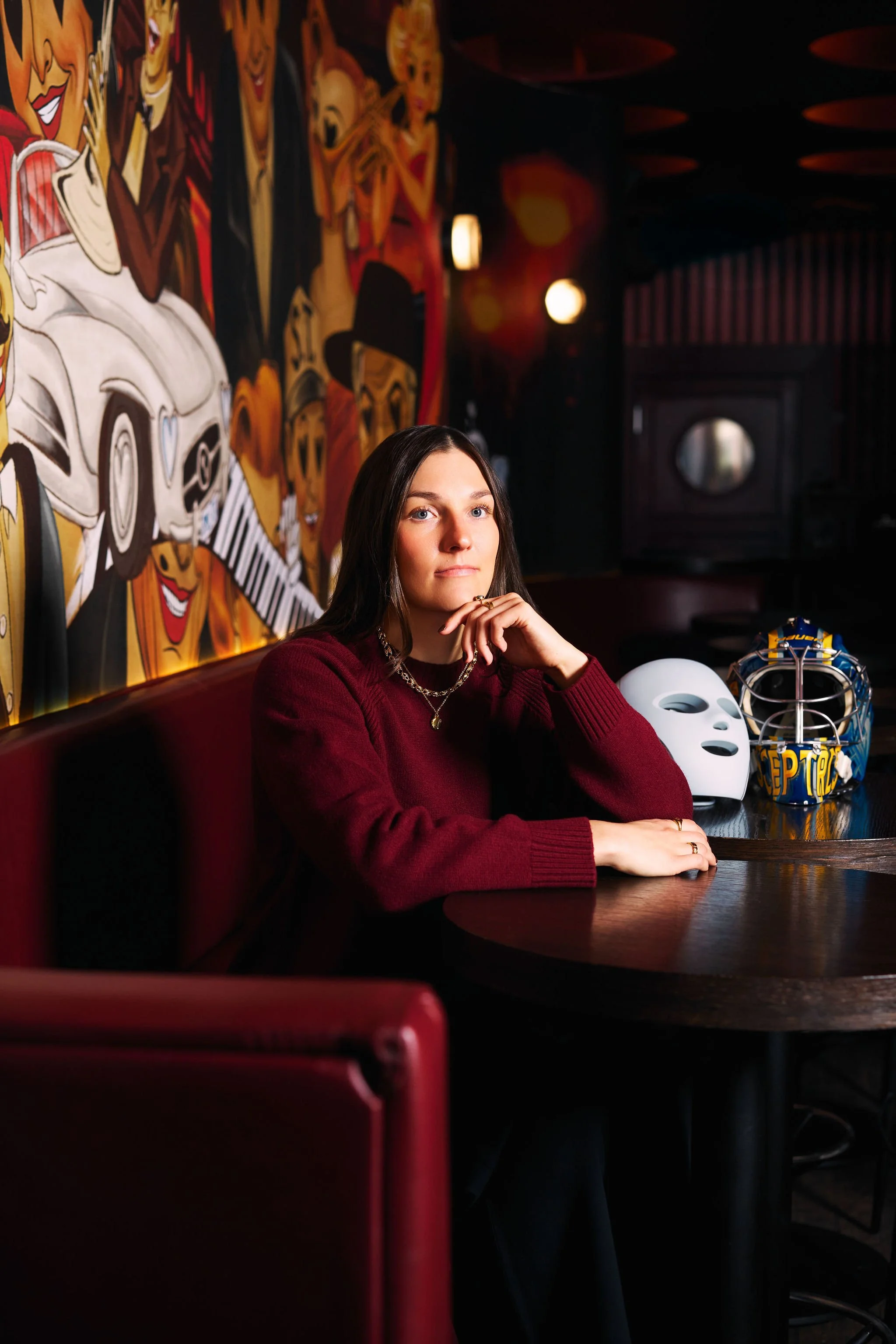
Venue: Small Talk, Toronto

By the time Raygan Kirk joined the PWHL, she already knew what it meant to adapt.
After growing up in a small Manitoba town, she moved through two very different college programs and entered the pro ranks at a moment when women’s hockey was reshaping its own future in real time. The league she once watched develop from afar was suddenly not just viable, but visible — selling out arenas, expanding to new markets and asking its players to grow up fast alongside it.
Now in her second PWHL season, the Toronto Sceptres goaltender finds herself navigating more than just shooters and traffic in the crease. There’s the grind of a travel-heavy schedule, the emotional weight that comes with playing the most scrutinized position on the ice, and the quieter challenge of making Toronto feel like home.
Kirk speaks easily about routine, about the comfort she finds in structure, and about the importance of knowing when to leave hockey at the rink. She lights up when the conversation turns to coffee shops, long walks and the team book club she accidentally ended up running. And she’s thoughtful — almost protective — when talking about younger players, college hockey and the paths she hopes remain open for the next generation.
In the middle of a season marked by league growth, packed buildings and heightened expectations, Kirk is learning how to stay grounded. For her, that means finding joy in the small things, trusting the process when things feel heavy and believing that she belongs exactly where she is.
IW: When you look back at the path that’s led you here, when did it start to feel like hockey could actually be your life?
Kirk: I think growing up in a very small town, hockey was always something I loved, but you don’t really know where it can take you. I knew I wanted to go to college for hockey, but beyond that, there was always the question of what comes next.
When I was in high school, the CWHL was around, and that felt like this really big dream — playing in Canada, continuing after college. There were also the PHF leagues, and even the idea of going to Europe. Continuing hockey after college was always something I really wanted to do.
But I think what really made it feel real was the timing of everything. In my final year of school, getting to watch the PWHL and seeing that this was actually happening — that there was going to be a draft, that you could make a living playing hockey — that’s when it really sunk in.
Watching that first game, it felt like maybe I wouldn’t have to go overseas. Maybe I wouldn’t have to get a “real job” right away. This could actually be the path.
“I think sometimes, as a taller goalie, people don’t necessarily see you as the most athletic. There’s this idea that smaller goalies are the ones making the really flashy saves. But being able to battle, to compete in the crease, and still make those big, desperation saves when you need them — that’s something I really pride myself on.”
What part of your game do you feel has evolved the most since college?
I think confidence, honestly. Confidence in knowing that I can play with the best players in the world.
I played at two very different colleges. I started at Robert Morris University, which was a smaller program, and then transferred to Ohio State, where we were very dominant and won a national championship. Getting to experience both ends of that spectrum helped me a lot.
At the pro level, you might get a game where you’re seeing a ton of shots, and then another where you’re not seeing many at all. Being able to stay mentally engaged, stay solid and be that calming presence back there — that’s something I’ve really leaned on from those experiences.
Is there a part of your game you think people underestimate?
I think sometimes, as a taller goalie, people don’t necessarily see you as the most athletic. There’s this idea that smaller goalies are the ones making the really flashy saves. But being able to battle, to compete in the crease, and still make those big, desperation saves when you need them — that’s something I really pride myself on. I might look more structured and calm, but I can still make those chaotic saves when the moment calls for it.
The PWHL schedule can be intense. How has playing at this level forced you to grow off the ice?
College was so routine. Every Monday looked the same, every Wednesday looked the same. Pro hockey isn’t like that at all. Now you might play Friday, Saturday one week, then Tuesday, then fly or bus and play Thursday. You really have to adapt your routine and figure out how to take care of your body through all that travel.
Our trip from Toronto to Seattle, for example, was a grind. So learning what recovery looks like for you — when to rest, when to move — that’s huge.
At the same time, you also want to enjoy where you are. A lot of us aren’t from the cities we’re playing in. I want to be in Toronto for a long time, so I need to get to know it and feel comfortable there. Exploring the city, spending time with teammates — that all matters too.
“College hockey is still so important — socially, educationally, personally. I learned so much just growing up through those years. Everyone in this league went to college, and that matters.”
When you’re on the road, what’s been a memorable city experience for you?
New York has been a big one. Last year we were there during the Four Nations, and we had a full day off. We took public transportation, found a random bar and watched the games like total tourists.
Seattle has been amazing for coffee. We’re a big coffee team, so finding small local shops has been fun.
We also love just walking around before games. It’s such an easy way to see a city. The Takeover Tour games have been especially cool for getting to explore parts of the country you might not otherwise spend time in.
Who on the team is always up for that kind of adventure?
Emma Maltais, for sure. I played with her for one year at Ohio State, and she was actually one of the first people to reach out when I entered the transfer portal.
She’s my road roommate, and we live in the same building in Toronto now, so we’ve become really close. She’s always down to explore, to try something new, to go for a walk — all of it.
What have been some of the things that make Toronto feel like home for you?
There’s just always something going on. I love the One of a Kind Craft Show — there’s one in the fall and one in the spring. Emma likes to come to that too and we’ll spend hours there. It’s all Canadian vendors, lots of jewelry, art, clothing, food. It’s one of our favorite things.
We also just love roaming — Ossington, Kensington Market, popping into little shops and cafés. Toronto makes it easy to do that.
Attendance across the league has been incredible this season, especially on the Takeover Tour. What does that feel like from your perspective?
It’s honestly hard to put into words. Halifax stands out. That was our first Takeover game there, and from the crease you really try to take a moment — maybe during a TV timeout — just to soak it in. The towels are going, the building is so loud you can barely hear yourself trying to communicate with your defence.
It’s incredible for the game and for the growth of the sport. You can feel how badly those cities want teams. The support we got in Halifax — from the open practice to just being around the city — was unreal.
Do you notice the fans more now? Are there faces you recognize?
Definitely at home. At Coca-Cola Coliseum, there are season ticket holders who are there every game, right at the glass. You start to recognize them.
I try not to spend too much time online — there’s a lot of good, but also a lot of negativity — but the support is real. My parents have been recognized in the stands wearing my jersey. People come up and say they love watching us play.
I’m biased, but I really think we have the best fan base.
What does a typical off day look like for you?
I usually still go to the rink. We’re really lucky to have access to the gym at Ford Performance Centre, so I’ll do mobility, stretching, that kind of thing.
Then it’s pretty simple — groceries, coffee, spending the afternoon at home. I love going for walks. I live with Claire Thompson this year, and she’s a big walker too, so we’ll go out in the afternoon.
I’m also a big reader. Evenings are pretty chill — sometimes girls come over, we’ll watch The Bachelor or Grey’s Anatomy together. Nothing too wild.
You’re also running a team book club. How did that start?
Some of the girls who came from Montreal had done it before and suggested it. I kind of took it and ran with it — accidentally became the president.
We read one book a month. There are about 16 of us, and you get one bye per season if you don’t want to read a book. This month’s pick is a little long, and I got some heat for that — but everyone voted for it, so I don’t want to hear it.
We meet for coffee, someone usually finds discussion questions online and we just chat. It’s actually been really great — a good way to connect outside the rink.
As a goalie, how do you take care of your mental health during the season?
I like to debrief a game and then move on quickly. I’ll watch my clips, take the positives, write things down — and then I try to leave it at the rink.
Especially as a goalie, you can’t dwell. You might be playing again in two days. Finding ways to wind down at night and mentally separate hockey from the rest of your life is huge.
There’s a lot of pressure on goalies in this league. How do you manage that?
You want to be the hero. You want to be the one who keeps the game close or gets the shutout.
But I’ve really tried to focus on what I can control. Staying away from online noise helps. Putting the work in at practice helps. Trusting that the team will find a way helps.
There are so many great shooters in this league. Knowing that I can make a save against the best — that confidence came from last year, and I carry it with me now.
Why do you think goalie development in women’s hockey is so strong?
There are a lot of really good goalie coaches, and a strong pipeline through Hockey Canada. In Manitoba especially, there’s always that joke about “what’s in the water.”
I’ve worked with some of the same coaches since I first put on pads. Having that consistency and access to good coaching makes a huge difference.
What do you hope younger players see when they watch you?
I hope they see opportunity. College hockey is still so important — socially, educationally, personally. I learned so much just growing up through those years. Everyone in this league went to college, and that matters.
You might not be able to retire at 30 in women’s hockey yet. Having your degree, having that experience — it sets you up for life.
Do younger players reach out to you? What do they ask?
Mostly about college — recruiting, when to talk to coaches, how to stand out. I always say: know what you want academically, look at roster needs, and personalize your emails. Find small connections. Keep it simple.
It’s stressful, and I remember that feeling. If I can help make it clearer, I want to.
Looking ahead, what are you most excited about right now?
Honestly, finishing this stretch strong. These games matter. Big picture? I want to keep playing in this league. Hopefully in Toronto. I want to push for Team Canada and see where that takes me. There’s still a lot I’m working toward — and that’s exciting.