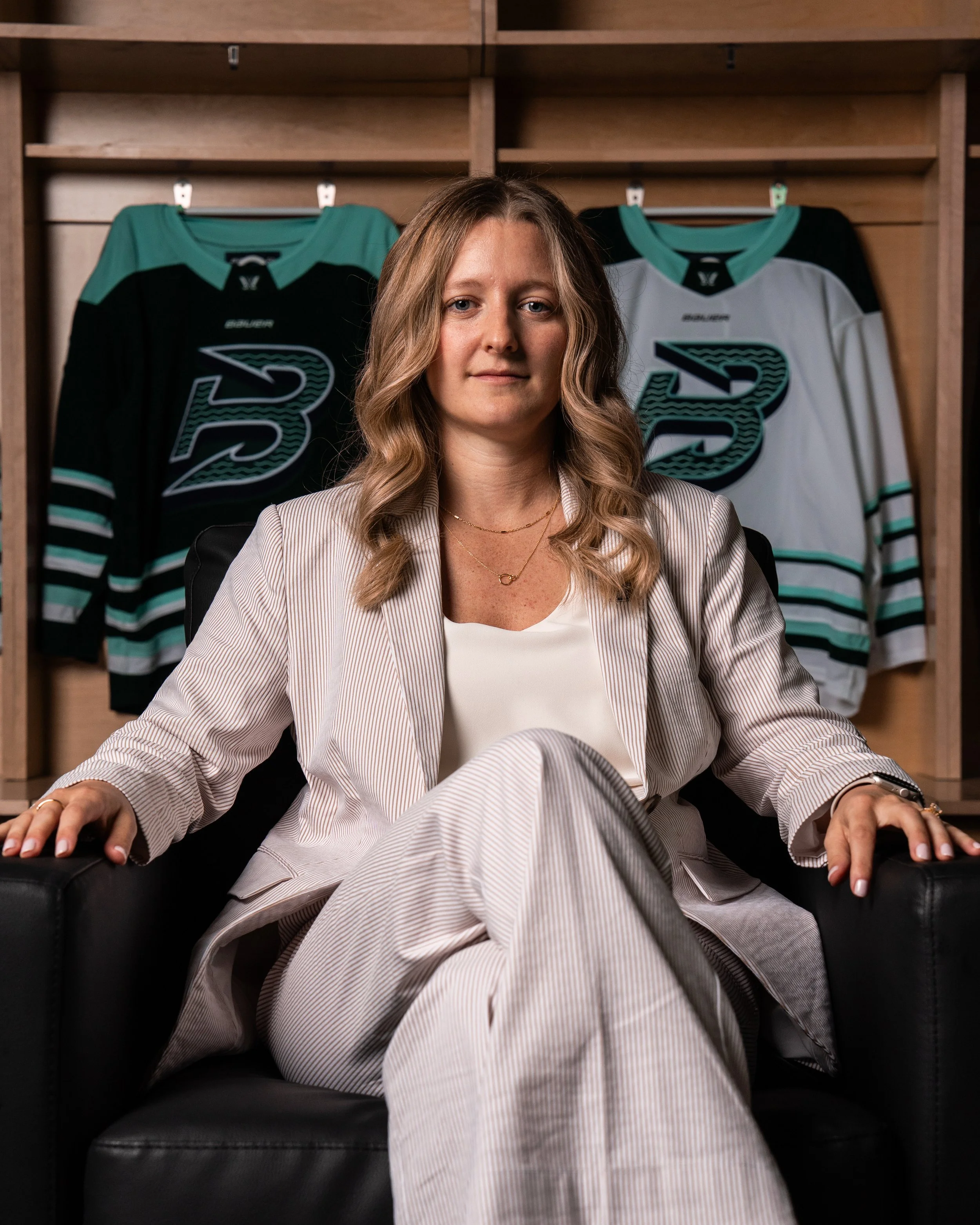
Building Something New in Boston
Danielle Marmer on leadership, culture and what women’s hockey is becoming
By Jolene Latimer

FROM THE SPRING/SUMMER 2026 ISSUE
It was past 2 a.m. in Seattle, and Boston Fleet general manager Danielle Marmer was still at the rink. She wasn’t signing a player or negotiating a trade. Instead, the head of the organization was doing something far more foundational: unloading equipment.
“My job on the road is to make sure that I’m putting out fires,” she said. “I’m not operational… we have athletic trainers who need to be on, we have coaches who need to be on… If I’m tired the next day, it’s okay.”
That mindset – step in, solve the problem, keep things moving – has come to define Marmer’s approach to leadership. It shows up in the quiet, unglamorous moments, but also in the decisions that shape a team: how a roster is built, how leadership evolves, and what kind of culture takes hold.
We caught up with Marmer to talk about all of it – leadership, identity, and what it takes to build something that lasts in a league still finding its footing.
Ice Warriors: Talk about a breakout year, not just for the Fleet but for individual players on your team. Did you ever think you’d have an athlete on Saturday Night Live, and what was your reaction when Megan Keller got the call from 30 Rock for that opportunity?
Marmer: With Keller, that meant getting on a plane at 5:00 am to go to SNL. I told her to go, and I told her you need to go to the after parties.
IW: You had a fan event after the Olympics where Megan Keller refused to leave until every fan had been through the line. What did that say to you about her leadership?
Marmer: We were the ones trying to cut the line… and Megan Keller said, ‘No, if the people are here, I’m going to stay and meet them. I don’t care how long it takes. She got through every single person. I can’t think of any other pro athlete at her level, with her accomplishments and her resume who would say that.
“I had a lot of self-doubt along the way. It was like, I can’t do this – whether it was working in the NHL (as a scout with the Boston Bruins) or even earlier. I didn’t see people who looked like me in those roles, and I didn’t always feel like I belonged.”
IW: When you think about leadership, how much of it is something you can identify early versus something that develops when a player is put in the position?
Marmer: I think we sometimes miss it. We assume someone can’t lead just because they haven’t had to yet.
“When you have someone like Hillary Knight… you just defer. It’s whatever Hillary wants… (Megan) wasn’t always going to speak up, because Hillary was going to.
I don’t know if she necessarily knew how she was going to be a leader… but you remove Hillary from it, and then Megan gets to evolve… and she’s become an incredible captain in a pretty short amount of time. I think that’s a miss on all of us to think that that wasn’t in there the whole time.
IW: How much of your job is evaluating talent versus evaluating people – how they fit, how they lead, how they impact a room?
Marmer: You’re dealing with people… you’re not just moving assets around. There’s a core that you’re investing in, this is our identity as a Fleet. And then it’s the complementary pieces that you’re always trying to upgrade on. But it’s hard, because you’re thinking about how someone fits, what they bring to a room, not just what they do on the ice.
IW: Your path to this role wasn’t linear. How has that shaped how you lead?
Marmer: I had a lot of self-doubt along the way. It was like, I can’t do this – whether it was working in the NHL (as a scout with the Boston Bruins) or even earlier. I didn’t see people who looked like me in those roles, and I didn’t always feel like I belonged.
I don’t think any of us can be fully objective in how we evaluate ourselves and what our capabilities are. So, you need people who are going to speak really highly of you and advocate for you, because that’s the only way I’ve gotten anywhere. That’s something I think about a lot now, because I’ve been on the other side of that.
IW: How does that influence how you work with your own staff?
Marmer: I want everyone to know that this might be your dream job today, but it doesn’t mean it’s going to be your dream job in five years. And whenever that time comes, I want to be the first person to help you get to whatever that next thing is.
I tell them, I want you to wear grass off so that when someone calls me, I can say you’ve got to hire this person. That’s how I’ve gotten any opportunity I’ve had – people speaking highly of me and advocating for me – and I think that’s part of leadership too.
“For a long time, women were told you’re role models before they were told they’re professionals. And now there’s this shift where they’re still role models, but they’re also getting to define what that means for themselves. And I think that’s really important for where the game is going.”
IW: What feels different about this league, from a leadership and culture standpoint?
Marmer: I think we have such a gift in that we’re adults watching a league start, so you can really see people grow into being ambassadors for the game.
You can see how they choose to represent the sport, how they choose to show love for it, and how they inspire people. And it’s interesting because every player takes on that responsibility in such a different way.
For a long time, women were told you’re role models before they were told they’re professionals. And now there’s this shift where they’re still role models, but they’re also getting to define what that means for themselves. And I think that’s really important for where the game is going.
IW: When you zoom out, what do you want the Fleet to represent within that?
Marmer: It goes back to that core. These are players we believe in, players we want to build with long term, players who represent what we want this team to be.
That becomes your identity. And once you have that, everything else – how you play, how you lead, how you connect with people – starts to build off of that.
IW: What have you noticed about how Boston has embraced women’s hockey – and what makes it a good place to travel to for fans who want to watch this league right now?
Marmer: I think what surprised me is that our fans aren’t necessarily the same people who are going to men’s professional sports. It’s a really different fan base… everybody wants let’s have a great time, it’s a welcoming space. For people who want a place to feel a part of something and haven’t felt like they fit in, it’s a really cool environment where people are just really excited to be there.